Switchgear Insulation Resistance Test Checklist Uk
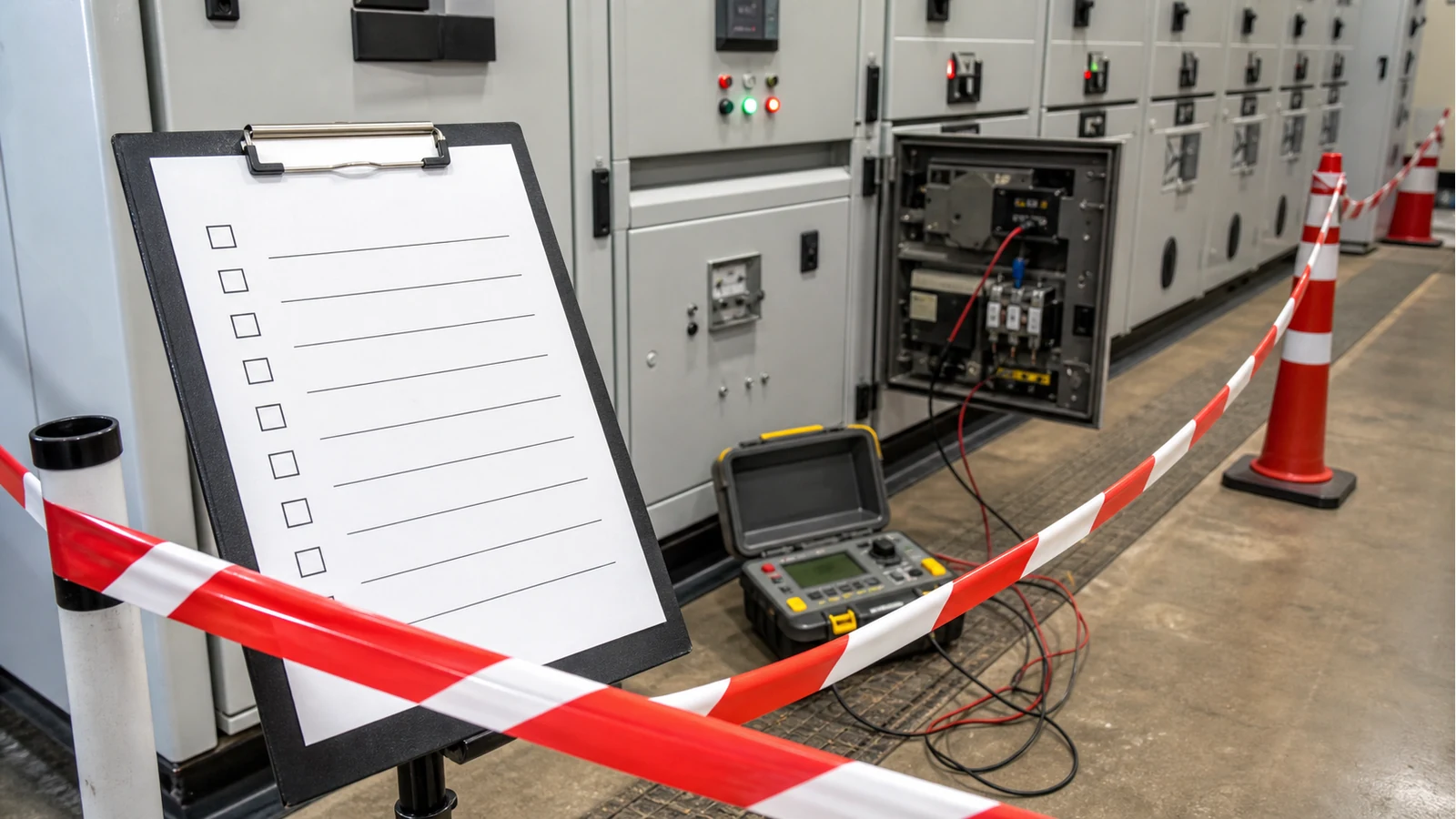
Direct answer: treat switchgear insulation resistance testing as a controlled dead-test task. The job needs competent people, isolation, proving dead, barriers, a written method, protection of connected electronics, recorded results and confirmed discharge before anyone removes test leads or re-energises.
This checklist is for planning and supervision. It is not a licence for untrained staff to test switchgear. If the job is on a utility network, under a sanction-for-test regime or inside a customer commissioning procedure, that procedure wins.
Pre-Job Checklist
- Confirm the asset, drawings, isolation points and test boundaries.
- Issue the permit or method statement required by the site.
- Isolate, lock off, tag and prove dead with suitable equipment.
- Set barriers so no one can enter the test area during high-voltage application.
- Brief the team on who controls the test, who records, and who is allowed inside the boundary.
- Confirm the selected test voltage from manufacturer, site or commissioning documents.
HSE's electrical testing at work leaflet is aimed at people who manage or carry out electrical testing and frames the job around controlling risk. Use that as the management lens: the danger comes from the test activity as well as the equipment under test.
Before Voltage Is Applied
Disconnect or protect devices that may be damaged or may distort the reading: relays, meters, transducers, surge devices, control wiring, VTs, auxiliary supplies and electronics. Inspect bushings and surfaces for moisture or tracking marks. If the switchgear has just moved from a cold store into a warmer room, condensation can make a result look worse than the insulation actually is.
Do not assume phase-to-earth and phase-to-phase checks are interchangeable. Write the exact connection pattern into the record. If one phase gives a suspicious result, stop and investigate rather than averaging it away.
Test Pattern As Orientation
UK network documents show why local procedures matter. SP Energy Networks' HV insulation testing document defines insulation resistance testing within a wider HV equipment procedure and says tests are carried out by authorised or trained persons using approved equipment. That is a company rule example, not a universal rule for every factory.
Electricity North West's CP319 commissioning document is another example of network-specific practice around commissioning checks. For a private plant room, those documents are useful orientation only. Your own manufacturer limits, customer specification and site rules still decide.
Checklist During The Test
- Call out before applying voltage and confirm the boundary is clear.
- Apply the specified DC test voltage for the specified duration.
- Record phase, connection, voltage, duration, reading, temperature, humidity and instrument ID.
- Watch for unstable readings, audible distress, unexpected leakage or operator concern.
- Stop if the result is unexpectedly low, inconsistent or outside the method statement.
- Discharge the asset through the approved path and wait until residual charge is safe.
After A Low Reading
A low or uneven result is not a pass/fail stamp on its own. Re-check isolation, connected devices, surface contamination and moisture. Compare with previous records only when voltage, duration and temperature context are comparable. If the result remains suspicious, keep the equipment out of service until the responsible engineer decides the next diagnostic step.
For voltage choice background, use the insulation test voltage selection guide. For procurement paperwork, use the calibration certificate buyer guide.